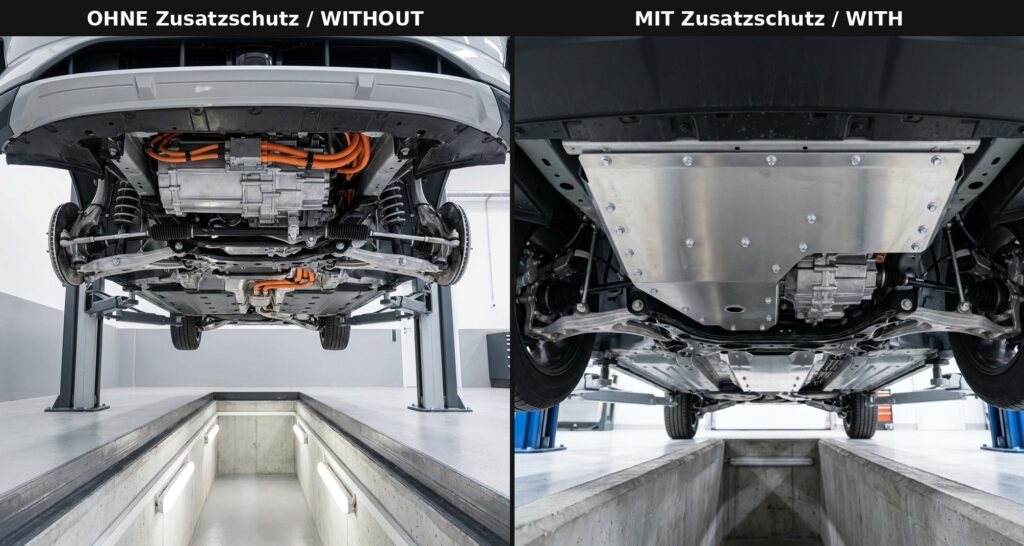
Ein Foto aus einer thailändischen EV-Werkstatt ist uns aufgefallen: ein Auto auf der Hebebühne, darunter eine frisch montierte Schutzplatte – nicht über dem Akku, sondern unter der Antriebseinheit (E-Motor und Getriebe) im Vorderwagen. Auf den ersten Blick wirkt das sinnvoll. Aber lohnt sich so eine zusätzliche Platte wirklich – oder ist es teures Zubehör, das die meisten gar nicht brauchen? Wir haben uns die Fakten angeschaut. Am Ende wollen wir vor allem eure Meinung dazu hören.
Vorher / Nachher: was sich am Unterboden ändert
Das Titelbild zeigt den Unterschied: links der Unterboden ohne Zusatzschutz – E-Motor, Getriebe und Kabel liegen offen. Rechts dieselbe Zone mit einer zusätzlich verschraubten Aluminiumplatte unter der Antriebseinheit.
Warum dieser Bereich überhaupt exponiert ist
Bei einem E-Auto liegen sowohl der grosse, flache Akku als auch die Antriebseinheit mit E-Motor und Getriebe im Unterboden – tiefer und grossflächiger als bei vielen Verbrennern. Genau diese Zonen trifft es bei Bordsteinkontakt, Schlaglöchern und den in Thailand allgegenwärtigen Speed Bumps zuerst.
Was Hersteller schon ab Werk einbauen
Die meisten E-Autos haben bereits werksseitig Schutzplatten aus Stahl, Aluminium oder Verbundwerkstoff – über dem Akkugehäuse und im Bereich der Antriebseinheit. Hersteller gehen davon aus, dass Einschläge mit Geröll oder Schotter im normalen Fahrbetrieb vorkommen – deshalb werden diese Bereiche von Anfang an verstärkt konstruiert.
Zusätzliche Platte unter der Antriebseinheit: Plus und Minus
- Plus: zusätzliche Reserve gegen Steinschlag und Bordsteinkontakt direkt unter Motor und Getriebe, besonders auf schlecht ausgebauten Strecken
- Minus: zusätzliches Gewicht und Kosten, teils Überschneidung mit dem Werksschutz
- Wichtig: schützt nicht vor Hochwasser – das hängt von der Abdichtung von Akku und Antriebseinheit (z. B. IP67/IP68) ab, nicht von einer Blechplatte darunter
- Zu klären: ob eine Nachrüstplatte die Kühlluftführung zum Motor beeinflusst
Der Thailand-Faktor: Speed Bumps, Baustellen, Regenzeit
Unangekündigte Speed Bumps, Baustellenschwellen und überflutete Strassen in der Regenzeit machen die Frage hier konkreter als anderswo. Ob sich eine zusätzliche Platte unter der Antriebseinheit lohnt, hängt stark vom eigenen Fahrprofil ab: viel Stadtverkehr mit Bodenwellen, Provinzstrassen oder eher Autobahn und Soi mit gutem Belag.
Was meint ihr?
Genau das wollen wir von euch wissen: Habt ihr eine zusätzliche Schutzplatte unter der Antriebseinheit nachgerüstet – und würdet ihr es wieder tun? Oder reicht euch der Werksschutz völlig aus? Schreibt eure Erfahrung gerne in die Kommentare auf unserer Facebook-Seite.
Häufige Fragen
Haben E-Autos ab Werk schon einen Schutz für Akku und Antriebseinheit?
In der Regel ja. Die meisten Hersteller verbauen ab Werk Schutzplatten über dem Akkugehäuse und im Bereich der Antriebseinheit, weil Kontakt mit Geröll und Bordsteinen als normaler Teil des Fahrbetriebs gilt.
Schützt eine zusätzliche Platte unter der Antriebseinheit auch vor Hochwasser?
Nein. Schutz vor Wasser hängt von der Abdichtung von Akku und Antriebseinheit selbst ab (typischerweise IP67 oder IP68), nicht von einer zusätzlichen mechanischen Platte am Unterboden.
Wie stark wirkt sich das Zusatzgewicht auf die Reichweite aus?
Je nach Material meist im niedrigen einstelligen bis niedrigen zweistelligen Kilogrammbereich. Der Effekt auf die Reichweite ist in der Regel gering, aber nicht null.
Lohnt sich die Nachrüstung für den Alltag in Thailand?
Das kommt auf Fahrprofil und Strecken an – und ist genau die Frage, zu der wir eure Erfahrungen sammeln wollen.
Mehr News und Diskussionen rund um Geely in Thailand gibt es auf unserer Facebook-Seite.
Allgemeine Diskussion, Stand Juni 2026; kein Produkttest und keine Kaufempfehlung, Bilder KI-generiert. Unabhängiger, inoffizieller Info-Kanal – keine Verbindung zu Geely Auto.