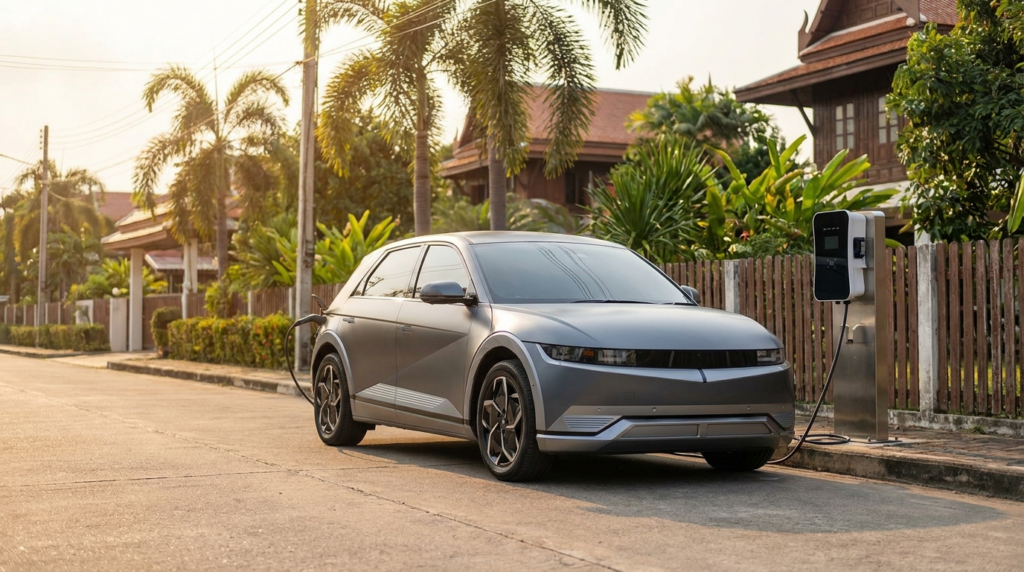
Kompakter grauer Elektro-Crossover lÀdt an einer Ladestation in Thailand

Geely EX2: Was kostet eine Woche Strom statt Benzin in Thailand?

Ein Elektroauto sei gĂŒnstig im Unterhalt – das hört man oft. Aber wie sieht es aus, wenn man eine ganz normale Woche damit fĂ€hrt, in Thailand, ohne Laborbedingungen? Eine Halterin aus der Geely-EX2-Community hat genau das gemacht: sieben Tage gefahren, Verbrauch und Ladekosten mitgeschrieben. Wir haben ihre Werte mit den aktuellen Strompreisen hier im Land zusammengebracht. Das Ergebnis ist deutlicher, als man denkt.

Was der EX2 wirklich verbraucht

Der Bordcomputer im Praxistest zeigte einen Verbrauch zwischen 8,5 und 9,3 kWh auf 100 Kilometer. Das ist ein realistischer Alltagswert fĂŒr einen kleinen Stromer – mit Klimaanlage, Stadtverkehr und etwas Überland gemischt. Zum Rechnen nehmen wir runde 9 kWh pro 100 Kilometer.

Was Strom in Thailand kostet

Bei den Preisen muss man zwei Welten auseinanderhalten: zu Hause laden oder an der öffentlichen SĂ€ule. Zu Hause richtet sich der Preis nach dem progressiven Tarif der staatlichen Versorger – MEA in Bangkok, PEA in den Provinzen. Wer viel verbraucht, zahlt inklusive aller ZuschlĂ€ge aktuell etwa 4,50 bis 6,50 THB pro Kilowattstunde (rund 0,12 bis 0,17 Euro). An öffentlichen Ladestationen liegt der Preis je nach Anbieter und Ladegeschwindigkeit höher: typischerweise 6 bis 12 THB pro Kilowattstunde (rund 0,16 bis 0,30 Euro), wobei Schnellladen (DC) teurer ist als normales Wechselstromladen (AC).

Die Wochenrechnung

Bei 9 kWh kostet die Strecke von 100 Kilometern zu Hause rund 40 bis 58 THB, an der öffentlichen SĂ€ule rund 54 bis 108 THB. FĂŒr eine Woche – nehmen wir wie im Beispiel eine Wenig-Fahrerin mit etwa 250 Kilometern:

LademöglichkeitKosten pro 100 kmEine Woche (≈ 250 km)
Zu Hause (PEA/MEA)40–58 THBca. 100–145 THB (≈ 2,70–3,85 €)
Öffentliche SĂ€ule54–108 THBca. 135–270 THB (≈ 3,55–7,10 €)
Annahme: 9 kWh/100 km, Wechselkurs rund 38 THB pro Euro. Preise schwanken je nach Anbieter, Tarifstufe und Ladegeschwindigkeit.

Anders gesagt: Eine Woche unterwegs fĂŒr den Gegenwert von zwei, drei Kaffees, wenn man zu Hause lĂ€dt.

Im Vergleich zum Benziner

Ein sparsamer Kleinwagen mit Benzinmotor braucht fĂŒr dieselben 250 Kilometer rund 15 Liter. Bei einem Spritpreis um 37 THB pro Liter sind das etwa 555 THB in der Woche. Der EX2 kostet zu Hause geladen also nur rund ein FĂŒnftel bis ein Viertel davon – Faktor vier bis fĂŒnf gĂŒnstiger, jede Woche, allein beim Tanken.

Fazit

Bei rund 9 kWh auf 100 Kilometer und thailĂ€ndischen Strompreisen kostet eine normale Woche zu Hause geladen oft weniger als 150 THB. FĂŒr viele ist nicht die Reichweite die Überraschung, sondern wie wenig am Monatsende auf der Stromrechnung dazukommt.

HĂ€ufige Fragen

Wie viel kostet es, einen Geely EX2 in Thailand eine Woche zu fahren?

Bei etwa 250 Kilometern und Laden zu Hause rund 100 bis 145 THB pro Woche. An öffentlichen SÀulen entsprechend mehr, meist zwischen 135 und 270 THB.

Wie hoch ist der Stromverbrauch des Geely EX2?

Im Praxistest zeigte der Bordcomputer 8,5 bis 9,3 kWh auf 100 Kilometer – ein typischer Alltagswert fĂŒr einen kompakten Stromer.

Lohnt sich Laden zu Hause gegenĂŒber der öffentlichen SĂ€ule?

Ja. Der Heimtarif liegt mit 4,50 bis 6,50 THB pro kWh deutlich unter dem öffentlichen Preis von 6 bis 12 THB. Wer kann, lĂ€dt ĂŒber Nacht zu Hause.

Mehr News und Tipps rund um Geely in Thailand gibt es auf unserer Facebook-Seite.

Electric cars are cheap to run – we hear that all the time. But what does it actually look like over one normal week of driving in Thailand, with no lab conditions? An owner from the Geely EX2 community did exactly that: seven days behind the wheel, logging consumption and charging cost. We lined her figures up against the current electricity prices here. The result is clearer than you’d think.

What the EX2 really uses

In real-world use, the trip computer showed consumption between 8.5 and 9.3 kWh per 100 kilometres. That’s a realistic everyday figure for a small EV – air conditioning on, city traffic, a bit of open road. For the maths we’ll use a round 9 kWh per 100 km.

What electricity costs in Thailand

Keep two worlds apart: charging at home versus the public charger. At home, the price follows the progressive tariff of the state utilities – MEA in Bangkok, PEA in the provinces. High-consumption households currently pay roughly 4.50 to 6.50 THB per kilowatt-hour including all surcharges (about €0.12 to €0.17). Public charging stations cost more, depending on operator and speed: typically 6 to 12 THB per kWh (about €0.16 to €0.30), with DC fast charging dearer than ordinary AC charging.

The weekly bill

At 9 kWh, 100 kilometres costs around 40 to 58 THB charged at home, and around 54 to 108 THB at a public charger. For one week – a low-mileage driver covering about 250 kilometres:

Charging optionCost per 100 kmOne week (≈ 250 km)
At home (PEA/MEA)40–58 THBapprox. 100–145 THB (≈ €2.70–3.85)
Public charger54–108 THBapprox. 135–270 THB (≈ €3.55–7.10)
Assumption: 9 kWh/100 km, exchange rate about 38 THB to the euro. Prices vary by operator, tariff tier and charging speed.

Put another way: a week on the road for the price of two or three coffees if you charge at home.

Against a petrol car

A frugal petrol hatchback needs around 15 litres for the same 250 kilometres. At a pump price near 37 THB per litre, that’s about 555 THB a week. Charged at home, the EX2 costs only about a fifth to a quarter of that – four to five times cheaper, every week, on fuel alone.

Bottom line

At around 9 kWh per 100 kilometres and Thai electricity prices, a normal week charged at home often costs less than 150 THB. For many people the surprise isn’t the range – it’s how little gets added to the electricity bill at the end of the month.

Frequently asked questions

How much does it cost to drive a Geely EX2 for a week in Thailand?

At about 250 kilometres and charging at home, roughly 100 to 145 THB a week. At public chargers, more – usually between 135 and 270 THB.

What is the Geely EX2’s electricity consumption?

In real-world testing the trip computer showed 8.5 to 9.3 kWh per 100 kilometres – a typical everyday figure for a compact EV.

Is home charging worth it compared with public charging?

Yes. The home tariff at 4.50 to 6.50 THB per kWh is well below the public price of 6 to 12 THB. Charge at home overnight whenever you can.

For more news and tips about Geely in Thailand, follow our Facebook page.

Verbrauchswerte aus einem Erfahrungsbericht, Strompreise Stand Juni 2026; Wechselkurs gerundet mit 38 THB pro Euro. Symbolbild (generisch, kein exakter EX2). UnabhĂ€ngiger, inoffizieller Info-Kanal – keine Verbindung zu Geely Auto. · Consumption from an owner report, electricity prices as of June 2026; exchange rate rounded at 38 THB to the euro. Symbolic image (generic, not an exact EX2). Independent, unofficial channel – not affiliated with Geely Auto.

Schreibe einen Kommentar

Deine E-Mail-Adresse wird nicht veröffentlicht. Erforderliche Felder sind mit * markiert

Nach oben scrollen